
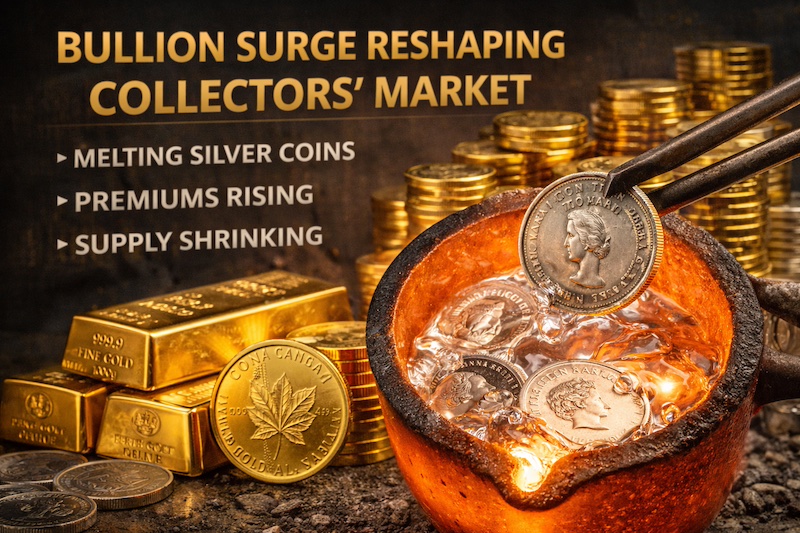
f you’ve been stacking silver rounds, buying sovereign coins, or hunting for “cheap junk silver”, the rules of the game are changing—fast. A bullion surge reshaping collectors’ market isn’t just a catchy headline; it’s a real shift that can permanently alter what’s available, what it costs, and what coin investors should prioritize next.
In Canada, this dynamic is already showing up in a way collectors haven’t seen in decades. According to Canadian Coin News (Jan. 20, 2026), soaring gold and silver prices—fueled by political, economic, and geopolitical uncertainty—are driving global demand and accelerating the melting of common-date Canadian silver coins. As those coins disappear into the “melt pot,” the publication warns that supplies may shrink permanently and premiums could rise.
Even if you’re a U.S.-based investor, this matters right now for one big reason: North American coin markets are tightly connected. When melting increases in one major market, it can ripple into availability, premiums, and collector behavior elsewhere—especially for widely traded products and cross-border dealer networks.
Why This Matters Now: Volatility, Currency Moves, and “Bullion-as-Insurance” Demand
The immediate backdrop is whiplash-level volatility. The same Canadian Coin News piece opens by noting that gold and silver prices fell sharply that morning as a stronger U.S. dollar triggered heavy selling across bullion markets. That’s a helpful reminder for investors: even in a bull market, sharp pullbacks can happen quickly—especially when currency markets move.
But the bigger story is demand. Long-time Winnipeg dealer Ian Laing of Gatewest Coins (as quoted in the article) points to a global rush into precious metals—particularly from buyers in Asia—who treat bullion “as insurance.”
That “insurance” framing is consistent with how precious-metals strategists often describe gold and silver during periods of uncertainty. The Financial Times has also discussed how silver’s return to record territory revives comparisons to earlier boom-bust cycles, emphasizing silver’s tendency toward larger swings than gold.
The key investor takeaway
When bullion demand surges, it doesn’t stay neatly confined to bullion products. It spills into:
- circulating-coin melt (older silver coins get scrapped),
- collector premiums (scarcer supply meets steady collector interest), and
- modern numismatics (mints and dealers struggle to balance investor and collector demand).
Bullion Surge Reshaping Collectors’ Market: How Melting Changes the Supply Forever
Here’s the part many investors underestimate: once common-date silver coins are melted, they don’t come back.
Laing warns that high silver prices are “accelerating the melting of common-date Canadian silver coins,” wiping out entry-level collectibles that historically served as an affordable gateway into the hobby. In plain English: when melt value rises high enough, people stop viewing these coins as collectible objects and start viewing them as raw metal.
Why melting spikes during big bullion moves
Melting tends to accelerate when all three conditions line up:
- High spot price (melt value becomes compelling)
- Thin premiums on common material (collector upside feels limited)
- Fast price momentum (fear of missing peak melt values)
For U.S. investors, there’s a close parallel: when silver spikes, “junk silver” (pre-1965 U.S. dimes/quarters/halves) can also see elevated turnover, tighter supply, and premium volatility—especially for coins that were once “easy to find” at a small markup.
What rises when coins vanish?
When supply shrinks, three things tend to rise over time:
- Replacement cost (dealers must pay more to restock)
- Premiums (especially on better-condition “common” coins)
- Collector selectivity (buyers shift toward higher-grade or scarcer dates)
Canadian Coin News explicitly flags this risk: as more coins disappear into the melt pot, “premiums are expected to rise and supplies to shrink permanently.”
A Quick Primer: Bullion Coins vs. Numismatic Coins (and Why the Line Is Blurring)
In a calm market, it’s easy to separate “bullion” from “collectible.” In a surge, the categories collide.
| Category | What drives value | Typical buyer | What changes in a bullion surge |
|---|---|---|---|
| Bullion products (coins/bars priced near spot) | Metal content | Investors, stackers | Premiums can jump; availability tightens |
| Common-date silver coinage | Mostly metal value | Entry collectors, silver buyers | Melting rises; supply permanently declines |
| True numismatics (rarities/graded coins) | Scarcity + demand + condition | Collectors, investors | Can benefit from wealth effects, but not always |
| Modern issues (limited series, special releases) | Theme + mintage + marketing | Collectors, gift buyers | May face demand shocks and supply constraints |
The blurring happens because “entry-level collectibles” can become bullion substitutes when silver rises—right up until the melt value tempts sellers to liquidate.
Bullion Surge Reshaping Collectors’ Market: Lessons From the 1980 Silver Spike
Whenever silver goes vertical, the market eventually brings up 1980—and for good reason.
The period tied to the Hunt brothers’ attempt to corner the silver market culminated in “Silver Thursday,” when prices fell dramatically after the squeeze unraveled. Encyclopaedia Britannica summarizes Silver Thursday as the sharp drop on March 27, 1980, following that cornering attempt. Wikipedia details that silver’s London fix rose to a record near $49.45/oz in January 1980, with COMEX futures hitting around $50.35/oz intraday.
Canadian Coin News notes that the current story explicitly explores how today compares with the Hunt brothers era.
What’s similar (and what’s different) for today’s investors
Similarities
- Rapid price appreciation draws in new buyers
- Headlines amplify fear and urgency
- Volatility increases (especially in silver)
Differences
- Today’s demand can be driven by broader macro uncertainty and global flows (not just a single concentrated squeeze)
- The market structure is more regulated and transparent than 1980
- Industrial demand dynamics matter more for silver than many collectors realize
The point isn’t “a crash is guaranteed.” It’s that the 1980 episode is a sober reminder: silver can move faster than most portfolios are built to handle.
Where the Royal Canadian Mint Fits In (and Why U.S. Buyers Should Care)
The Canadian Coin News feature indicates the situation has reached a point where the Royal Canadian Mint is struggling to meet demand, and it also discusses how rising metal prices are affecting modern numismatic issues.
To stay conservative (and YMYL-safe): that’s the publication’s framing, and it aligns directionally with how mints can face pressure during surges—higher demand, tight blanks, production bottlenecks, and distribution constraints.
Separately, the Royal Canadian Mint’s official 2024 performance release shows bullion volumes can swing meaningfully year to year, reflecting how sensitive the business is to demand conditions and market pricing.
For U.S. investors, the practical implication is straightforward:
- When flagship North American mints get stretched, premiums and lead times tend to become less predictable.
- That unpredictability can spill into U.S. dealer inventories and secondary markets—especially for globally recognized products.
Practical Playbook: What U.S. Coin Investors and Bullion Buyers Can Do Now
If you want to make smart moves in a bullion-driven collector market, focus on process—not predictions.
1) Separate your “metal stack” from your “collector book”
Think in two buckets:
- Stack (bullion strategy): low premiums, high liquidity, position sizing
- Collect (numismatic strategy): rarity, condition, long-term demand
This reduces the temptation to overpay for semi-collectibles when your real goal is metal exposure.
2) Watch melt pressure indicators
Melting accelerates when:
- spot rises rapidly,
- spreads/premiums narrow on common material, and
- sellers believe the move is temporary.
If you collect Canadian silver (or U.S. 90%), assume “easy supply” can disappear quickly in surges.
3) Buy liquidity first, story second
In stressed markets, liquidity wins. Prioritize:
- widely recognized bullion coins,
- common bar sizes from reputable manufacturers,
- products you can resell easily without “explaining the story.”
4) Manage volatility like a pro
Silver’s history argues for humility. The FT has highlighted how silver’s record territory invites comparisons to prior booms and underscores its volatility relative to gold.
Use guardrails:
- dollar-cost average (DCA) instead of lump-sum buys at peaks
- avoid leverage unless you truly understand the risks
- keep an emergency cash buffer so you don’t become a forced seller
5) Look for collector opportunities created by chaos
Laing’s warning is also a clue: as entry-level coins disappear, certain surviving categories can benefit long term. Examples:
- better-condition examples of formerly “common” coins
- complete date sets where missing coins become harder to source
- niche series where collector demand is steady regardless of spot
Pros and Cons: A Balanced View of Bullion-Driven Coin Markets
Benefits
- Potential upside from scarcity: melting can permanently tighten supply
- Renewed interest in the hobby: new investors often become collectors
- Liquidity improves for bullion-adjacent items: more buyers, more turnover
Risks
- Premium risk: you can overpay during hype and struggle to recoup premiums later
- Volatility risk (especially silver): history shows sharp reversals are possible
- Quality dilution: in hot markets, questionable “rare” claims and overpriced modern issues can proliferate
Conclusion: Adapt Now—or Pay More Later
A bullion surge reshaping collectors’ market is not a short-term curiosity. When high silver prices drive melting, the coin ecosystem can change permanently—fewer entry-level coins, tighter supply, and higher premiums over time.
For U.S. gold and silver investors, the winning approach is balanced and disciplined:
- keep bullion buying focused on liquidity and premiums,
- treat collecting as its own strategy (not an impulse buy),
- and respect silver’s volatility—because history shows it can turn on a dime.
Optional call-to-action: If you’re building or refining a precious-metals plan, write down your allocation target, your preferred products, and the premium thresholds you’re willing to pay—before the next surge makes emotion the loudest voice in the room.
FAQ
- Why do high silver prices cause coin melting?
Because melt value can exceed what owners believe they’d get from selling as a collectible—so coins get treated as raw metal. - Does melting really reduce future supply permanently?
Yes—once coins are melted, they’re removed from the collectible pool, which can tighten supply and lift premiums over time. - Is this similar to the 1980 silver spike?
There are parallels in volatility and investor behavior, and Silver Thursday remains a cautionary case study from 1980. - What should U.S. buyers prioritize during a surge?
Liquidity, reasonable premiums, and a staged buying plan—especially for silver, which tends to swing harder than gold. - Are there opportunities for collectors right now?
Potentially—but the market may reward adaptability, quality, and long-term scarcity rather than impulse buying.