
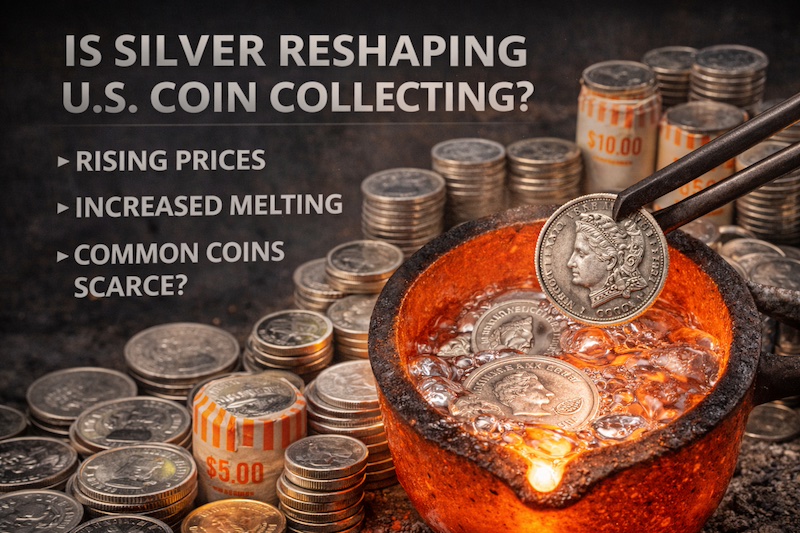
Picture this: a roll of 1964 Roosevelt dimes—once the definition of everyday “junk silver”—now treated like a dwindling resource. Or bags of Morgan and Peace dollars, historically abundant in the U.S. coin trade, quietly being sent to refiners because the metal inside is suddenly worth more than the market’s patience for sorting dates and grades.
That’s the uncomfortable (and increasingly realistic) premise behind the debate over silver reshaping U.S. coin collecting—a new phase where familiar silver coins may become harder to source at reasonable premiums, not because collectors suddenly became obsessed with them, but because melting and industrial demand are changing the math.
This isn’t alarmism for clicks. It’s a real-world collision of three forces:
- Explosive silver price volatility
- Strained refining capacity and scrap flow bottlenecks
- Industrial buyers consuming more silver than many collectors realize
If you’re a U.S. bullion buyer, a coin investor, or a collector who built sets assuming “there will always be more,” this is a moment to understand what’s happening—because the market incentives are shifting right under your feet.
TL;DR
- The idea of silver reshaping U.S. coin collecting centers on rising silver prices + increased melting activity making even common silver coins less available over time.
- Reports suggest refiners and dealers have faced scrap bottlenecks and tighter buying at times, which can distort premiums and availability.
- Silver’s fundamentals are increasingly industrial: the World Silver Survey 2025 highlights persistent market deficits and record industrial demand in recent years.
- The U.S. Mint has also repriced silver products sharply in 2026, reinforcing how higher input costs and demand pressure flow into retail coin markets.
- Best move: separate “stacking” from “collecting,” manage premium risk, and don’t assume common-date supply is permanent.
Why This Matters Now: Silver’s “Two-Engine” Market (Money Metal + Industrial Metal)
Gold is largely monetary. Silver is monetary and industrial—and that second engine is getting bigger.
The Silver Institute’s World Silver Survey 2025 (produced by Metals Focus) describes a market that has experienced repeated supply-demand strain, including a significant deficit and record industrial demand in recent reporting periods.
Meanwhile, mainstream business coverage has highlighted how solar expansion is a major tailwind for silver demand because of silver’s unmatched conductivity—one reason silver can behave like a commodity in a way gold rarely does.
What that means for collectors: when silver rallies, it’s not just investors bidding it up. It’s also manufacturers competing for the same finite metal pool—often through long-term procurement channels that don’t care about your Whitman folder or your Dansco album.
Silver Reshaping U.S. Coin Collecting: The Melting Incentive Nobody Can Ignore
In the source article, numismatic writer Richard Giedroyc argues we may be entering a phase where even commonly collected U.S. silver coins—like 1964 dimes and 1921 Morgan dollars—could become “expensive and rare” if melting persists.
Here’s the key mechanism: melt value sets a gravitational floor under silver coin prices. When melt rises fast enough, it changes behavior across the supply chain:
Why coins get melted during spikes
- Sorting becomes less profitable than selling as scrap
If the market is paying aggressively for silver weight, the incentive to carefully grade, attribute, and retail lower-end material declines. - Wholesale pricing can distort
The article points to reports of silver coins being priced near (or even under) melt at wholesale in some circumstances—conditions that can push material toward refiners rather than into collector hands. - Time becomes risk
If refiners are backlogged, dealers face a brutal tradeoff: wait to convert scrap into cash (while prices swing), or move inventory quickly—even if that means scrapping coins that “shouldn’t” be scrapped.
Refinery Backlogs: The Quiet Bottleneck That Warps Premiums
One of the more practical—and under-discussed—drivers here is refining capacity and the financing risk of carrying scrap during volatile markets.
In early 2026, industry commentary described periods when some refineries and wholesalers limited or paused purchases of certain silver scrap categories, citing processing and financing constraints.
Expert takeaway (paraphrased from industry commentary): when the system’s ability to process and hedge metal gets constrained, the market can temporarily “triage” what it will buy (e.g., favoring the most liquid forms), leaving other silver categories with worse bids or longer payment timelines.
For U.S. collectors and bullion buyers, this can show up as:
- sudden premium spikes on popular coins,
- unusually wide buy/sell spreads,
- “we’re not buying that today” signs at shops,
- and confusing price action where spot is high but liquidity feels weird.
U.S. Mint Repricing: A Real-Time Signal That Silver Inputs Are Stressing Retail Markets
When silver moves hard, government mints don’t just shrug—it affects their retail pricing.
In early 2026, reporting noted sharp price increases across U.S. Mint products, including large jumps for certain silver items and sets.
This matters because U.S. Mint pricing changes can ripple through:
- dealer expectations for retail pricing,
- secondary market premiums for American Silver Eagles and modern issues,
- and collector psychology (“if the Mint raised prices, should I buy now or wait?”).
Important nuance (YMYL reality check): Mint repricing isn’t a directional forecast for spot silver. It’s a reflection of production costs, distribution strategy, and demand dynamics—useful context, not a crystal ball.
Silver Reshaping U.S. Coin Collecting: What Happens If “Common” Coins Disappear?
Collectors often assume supply is permanent because it has felt permanent for decades. But melting changes that permanently.
Here’s what could plausibly become harder (and pricier) if sustained melting continues:
- Nicely circulated (problem-free) sets of Washington quarters
- Better-date or higher-grade “junk silver” coins (because the ugly stuff gets melted first)
- Low-end Morgan and Peace dollars
- Modern bullion issues if blank supply or repricing reduces affordability
Bullion vs. numismatic value: a simple framework
| Coin Type | Primary value driver | Risk in a melt-driven market | Opportunity |
|---|---|---|---|
| 90% “junk” silver | Melt + small premium | Premium volatility; supply drains | Accumulate on premium dips |
| Common Morgan/Peace dollars | Blend of collectibility + melt | Low-end coins get scrapped | Better-condition coins may separate in price |
| True numismatic rarities | Scarcity + demand | Less tied to melt; still cyclical | Quality/rarity can outperform |
| Modern silver bullion (ASEs, etc.) | Spot + premium | Mint repricing + supply constraints | Liquidity stays strong, but premiums can whipsaw |
A Historical Reality Check: Silver Spikes Can Be Violent (Up and Down)
Anytime silver enters a new “regime,” veterans remember one thing: it doesn’t move gently.
Recent coverage has highlighted just how extreme silver’s swings can be—surging to record levels and then pulling back sharply within days—underscoring why position sizing and patience matter.
Lesson for collectors and investors: scarcity narratives can be real, but you still need a strategy that survives volatility.
Practical Playbook for U.S. Investors and Coin Collectors
Here’s how I’d approach this as a bullion-market professional trying to stay rational in an emotional market.
1) Separate your goals: “stacking” vs “collecting”
- Stacking goal: maximize ounces per dollar with strong liquidity
- Collecting goal: build sets with condition/rarity considerations
Don’t fund one goal with the mistakes of the other (like overpaying collectible premiums when you really want metal exposure).
2) Track premiums, not just spot
In melt-driven markets, your real risk is premium compression:
- You buy at a 25–40% premium during a squeeze
- Spot holds steady
- Premiums normalize
- Your resale value disappoints
3) Be selective about “common-date” silver coins
If melting is removing lower-end supply, then eye appeal becomes more important over time. Buy coins you’d actually want to keep.
4) Don’t treat rumors as facts
The source mentions unverified rumors of state stockpiling. Treat those as unconfirmed market talk—interesting, but not investable without evidence.
5) Have a liquidity plan
If you’re buying:
- favor widely recognized products
- keep documentation and secure storage
- know where you’d sell before you need to sell
FAQ
1) Are 1964 dimes and other pre-1965 coins really becoming scarce?
Not “rare” in a classic numismatic sense—but sustained melting can reduce the pool of problem-free, nicely circulated material over time, which can lift premiums.
2) Are Morgan and Peace dollars actually being melted?
The source article cites reports of bulk quantities being shipped to refiners as scrap. Even if this is episodic, it’s directionally important because it shows melt incentives can override collector habits in extreme markets.
3) Why would refiners being backlogged matter to collectors?
When refining capacity and financing constraints tighten, dealers may change bids, spreads widen, and certain categories become temporarily illiquid—creating premium spikes and supply gaps.
4) Does U.S. Mint repricing mean silver will keep going up?
No. Mint pricing reflects costs and demand conditions—not a guaranteed forecast for spot. But it can influence premiums and buyer behavior in the retail coin market.
5) What’s the safest approach for new U.S. silver investors right now?
Avoid chasing headlines. Buy in tranches, prioritize liquidity, and watch premiums closely—especially on high-demand retail coins.
Conclusion: Adapt Your Strategy—Because the Incentives Have Changed
The most important idea behind silver reshaping U.S. coin collecting is simple: when silver gets expensive enough, coins stop being “coins” to some market participants and start being raw material.
If melting continues and refining bottlenecks persist, the long-term effect can be fewer common-date silver coins available, higher premiums for nicer examples, and a collector market that rewards adaptability over nostalgia.
Optional call-to-action: If you’re buying silver in 2026, write down your rules (products, premium limits, buy schedule, sell plan). In a market this emotional, discipline is a competitive advantage.