
If you buy coins or bars when the headlines get loud, Perth Mint’s latest numbers are worth your attention.
The Perth Mint closed 2025 with a story that perfectly captures today’s precious-metals market: prices surged, investor interest stayed high, yet physical bullion shipments ended the year mixed—with December sales down from November for both metals, while the full year showed gold up vs. 2024 and silver down.
For U.S. gold and silver investors—and especially coin and bullion buyers—this matters because Perth Mint is a bellwether for retail and wholesale appetite for minted precious metals products globally. When a major sovereign-style mint reports shifting demand between gold and silver, it often reflects changes in:
- investor psychology (risk-on vs. risk-off),
- affordability and “sticker shock,”
- product premiums and availability, and
- seasonality in retail buying.
Let’s break down what the Perth Mint bullion sales 2025 data actually says, why it happened against a backdrop of explosive price action, and how U.S. buyers can use these signals to make better decisions in 2026.
Why This Topic Matters Now: A Market Snapshot from 2025 into 2026
2025 was not a “normal” precious-metals year. It was the kind of year that changes behavior.
Financial press coverage into late 2025 described extreme volatility and outsized gains, particularly for silver, with reports noting silver’s dramatic moves and unusually strong annual performance. When prices rise that quickly, the physical market can react in two opposite ways:
- Momentum buying (more investors rush in), and
- Demand rationing (buyers pull back because products feel “too expensive,” premiums spike, or budgets tighten).
Perth Mint’s end-of-year numbers show elements of both—strong interest in trusted products, but a clear December cooling that’s consistent with both seasonal patterns and price-driven hesitation.
Perth Mint Bullion Sales 2025: The Key Numbers (Gold Up, Silver Down)
Here are the headline figures from the reporting:
December 2025: Both metals declined month-over-month
Perth Mint reported that in December 2025, it sold 35,885 troy ounces of gold and 597,873 ounces of silver in minted product form.
That represented a sharp month-over-month slowdown from November’s reported totals (66,710 oz gold; 875,487 oz silver).
Full-year 2025: Gold higher than 2024, silver lower
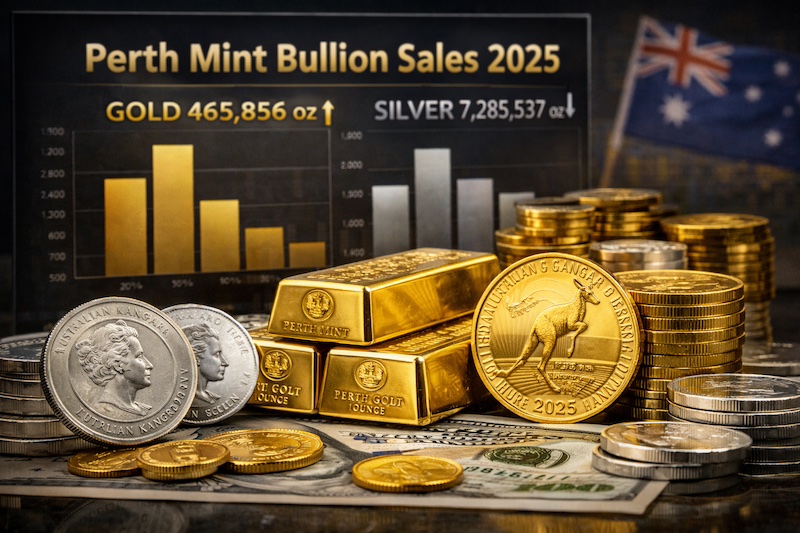
- Gold bullion (2025): 465,856 oz (higher than 2024: 391,606 oz)
- Silver bullion (2025): 7,285,537 oz (lower than 2024: 9,813,384 oz)
That’s the “mixed” result in one line: gold demand strengthened on the year, silver softened—even as silver’s price action grabbed headlines.
Perth Mint Bullion Sales 2025 and Seasonality: Why December Often Slows Down
One of the most useful parts of the report is the explanation from Perth Mint’s General Manager of Minted Products, Neil Vance, who pointed to a predictable reality of the physical market:
December is traditionally quieter as customers turn their attention to the holiday and festive season.
In other words: even when the macro story is bullish, the retail calendar still matters. For U.S. buyers, this seasonal lull can show up as:
- fewer “panic buys,”
- softer short-term premiums on certain products, or
- more stable dealer inventory after heavy fall buying.
But seasonality wasn’t the only factor.
Why Silver Fell (in Sales) Even as Prices Soared
At first glance, silver’s weaker full-year sales can seem counterintuitive—especially when 2025 performance was widely described as extraordinary.
In practice, here are the most common drivers that can reduce ounce volume even during a bull run:
1) Sticker shock and budget constraints
Silver is the “people’s metal,” but when it runs hard, retail buyers often hit budget limits. Many stackers buy by the tube or by the box; when the same basket costs far more, they may pause or buy less frequently.
2) Profit-taking and rotation
Some investors who accumulated silver earlier may sell into strength or rotate into gold for a more “defensive” posture.
3) Premium sensitivity
In fast markets, premiums can expand and confuse buyers: “Why is my coin price so far above spot?” That uncertainty can delay purchases.
4) Buyers still want silver—just specific products
Vance noted “particularly strong demand” for silver 1 oz kangaroo coins and 1 oz silver minted bars (including kangaroo and lunar designs).
That’s important: it suggests demand didn’t disappear—it concentrated into recognizable, high-liquidity formats.
What Drove Gold’s Stronger Full-Year Finish?
Gold’s full-year growth (vs. 2024) fits a classic pattern: when markets feel unstable, investors prioritize gold’s role as a portfolio anchor.
Vance highlighted that minted bars performed strongly, reinforcing their appeal as a core investment choice during market volatility.
For U.S. bullion buyers, that aligns with what many dealers see in real time:
- In uncertain markets, bar demand often rises because buyers want more ounces per dollar of premium.
- Coins remain popular, but higher premiums can push larger buyers toward bars.
How U.S. Investors Can Use These Signals in 2026
Perth Mint’s data doesn’t “predict” the future—but it does offer actionable clues about how real-world buyers behave when prices surge.
Three takeaways for U.S. coin investors and bullion buyers
- Demand can be strong without being uniform.
Even in bullish markets, buyers get selective—favoring the most liquid, trusted products. - Price action can reduce ounce volume.
When metals explode higher, fewer ounces can be purchased with the same dollars—so shipment volume can fall even if total dollar demand is steady. - Seasonality creates opportunity.
If December is quieter, it can sometimes be a window for disciplined accumulation—especially if premiums ease.
Coins vs. Bars vs. “Paper” Exposure: A Practical Comparison
If you’re investing from the U.S., you’re not just choosing metal—you’re choosing a vehicle. Here’s a simple framework:
| Option | Best for | Pros | Cons/Risks |
|---|---|---|---|
| Bullion coins (e.g., 1 oz sovereign-style issues) | Coin investors, liquidity-first buyers | Highly recognizable, easy resale, divisibility | Usually higher premiums; can spike in fast markets |
| Minted bars (1 oz–1 kg) | Premium-conscious stackers | Often lower premium per ounce; efficient for larger buys | Less divisible; brand/refinery recognition matters |
| ETFs/“paper” gold & silver | Convenience and trading | Liquidity, tight spreads, easy rebalancing | No personal possession; structural/counterparty considerations |
Pro tip (risk-managed approach): Many serious investors blend these:
- core holding in gold (stability),
- tactical allocation in silver (upside/volatility),
- and a product mix that matches liquidity needs.
Balanced Perspective: The Pros and Cons of Buying After a Big Run
Because this is a YMYL topic, here’s the honest view: buying during or after a surge can work—but it demands discipline.
Benefits
- Hedge value may be strongest when uncertainty is high.
- Physical ownership avoids certain financial-system dependencies.
- High-quality products (major mint coins/bars) tend to retain liquidity.
Risks
- Volatility risk: silver especially can move violently.
- Premium risk: paying elevated premiums can reduce near-term returns.
- Timing risk: sharp rallies often include sharp pullbacks.
A measured approach that professionals use:
Instead of “all-in” buys at emotional moments, consider staged buying (dollar-cost averaging) and define a target allocation that fits your risk tolerance.
Case Study: What Perth Mint’s December Update Tells Us About “Record-Price” Behavior
Perth Mint’s own December commentary noted gold opened around $4,200 and moved to a new record near $4,549 in late-December trading.
Yet minted product sales fell from November.
That’s a classic real-world pattern:
- prices hit records → headlines surge → some investors buy,
- but many others hesitate, wait for a pullback, or reduce ounce size.
For U.S. buyers, the lesson isn’t “don’t buy at highs.”
It’s “don’t buy emotionally at highs.” Use a plan.
FAQ
1) Why did Perth Mint’s December 2025 sales fall from November?
Perth Mint pointed to December seasonality, and the month also followed intense price moves that can cause buyers to pause or reduce ounce size.
2) What were Perth Mint’s full-year bullion totals for 2025?
Gold bullion totaled 465,856 oz and silver bullion totaled 7,285,537 oz for 2025 (minted products).
3) Does lower silver volume mean demand is weak?
Not necessarily. Strong price rallies can reduce ounce volume because products become less affordable; demand may also concentrate into specific items (like 1 oz coins/bars).
4) Are minted bars better than coins for investors?
Bars often offer lower premium per ounce, while coins typically offer better divisibility and recognizability. The “best” choice depends on your liquidity needs and budget.
5) How should U.S. investors respond to mixed bullion sales signals?
Use it as a behavioral signal: stay disciplined, consider staged buys, and choose high-liquidity products you can easily resell.
Conclusion: What Perth Mint Bullion Sales 2025 Really Tell U.S. Buyers
The key message from Perth Mint bullion sales 2025 isn’t that demand is fading—it’s that the physical market is getting more selective.
Gold finished the year stronger than 2024, reinforcing its role as the stability metal during volatility. Silver’s lower full-year ounces—despite a headline-grabbing year—suggests affordability, profit-taking, and premium sensitivity played a bigger role than many investors realize.
If you’re a U.S. bullion buyer or coin investor heading into 2026, a smart strategy looks like this:
- focus on trusted, liquid products,
- avoid emotional “headline buys,”
- and build exposure with a plan (especially when markets are moving fast).
Optional call-to-action: If you’re adding precious metals this year, define your target allocation, pick the right mix of coins and bars, and consider staged purchases to manage volatility—then review premiums and liquidity before each buy.