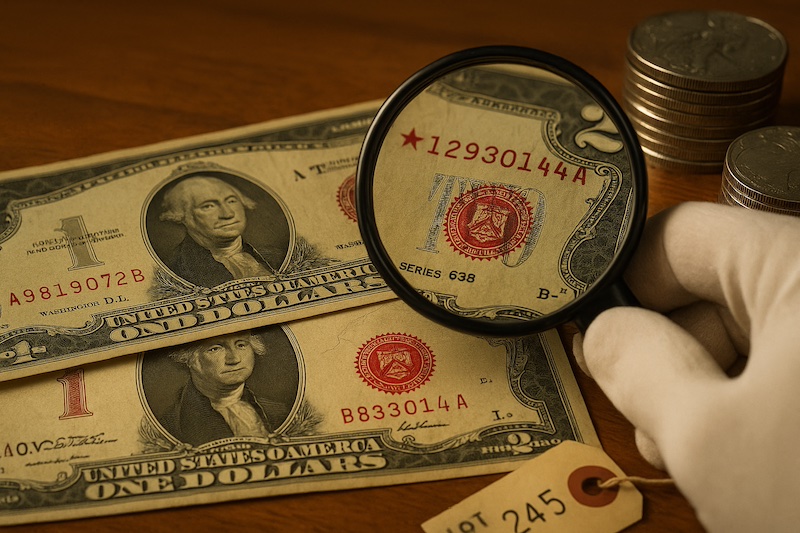
The most coveted small-size $1 and $2 Red Seal notes are the 1928 United States Notes especially star and mule varieties. They’re historically significant, legally valid, and scarce in top grade. Collect alongside bullion by focusing on rarity, originality, and authentication. Let condition and provenance drive your bids, not hype.
Why Red Seal Notes Are Having a Moment
The hard-asset resurgence driving demand for gold and silver is pulling more investors into numismatics as a diversification play. Within U.S. paper money, the red-seal United States Notes (USNs) stand out: first issued in 1862, they were the country’s first national paper currency, and the red Treasury seal makes them instantly distinguishable from blue-seal Silver Certificates and the green-seal Federal Reserve Notes in your wallet today.
What Is a United States Note?
United States Notes are legal-tender notes issued directly by the U.S. Treasury, not the Federal Reserve. The red seal identifies the family. Though no longer printed, they remain valid currency at face value. Seal color tells you note class and era, nothing more:
- Red seal – United States Notes (USNs)
- Blue seal – Silver Certificates
- Green seal – Federal Reserve Notes
The $1 Red Seal: A One-Year Type
There is exactly one small-size $1 note with a red seal: the 1928 $1 United States Note. Issued for a single year before the denomination shifted to Federal Reserve Notes, it’s a one-year type that anchors any small-size USN set.
Circulated examples are collectible and approachable. Star notes are another matter, replacement notes from this series are scarce, rarely surface at auction, and carry sharp grade premiums. Third-party certification is essential before bidding on one.
The $2 Red Seals: A Full Series
The $2 denomination spans six decades of red-seal issues:
- 1928 through 1928G – foundational early small-size issues
- 1953 through 1953C – postwar run
- 1963 and 1963A – the final red-seal issues
In 1976, the $2 bill returned as a green-seal Federal Reserve Note—a different type entirely, outside the USN tradition.
Within the red-seal $2 series, the 1928B star note is what specialists call a “super key” among the most coveted pieces in all of small-size U.S. currency. The 1953 and 1963 stars are far more available and make sensible entry points.
Star Notes: Why One Symbol Changes Everything
A star note is a replacement printed when a production sheet is damaged. The BEP adds a … to the serial number to flag it as a substitute. Replacement runs are small by nature, so stars from scarce series can be dramatically rarer than regular notes from the same year.
- A 1928 $1 red-seal star is a genuinely rare note; a regular example is not.
- The 1928B $2 red-seal star is a super key with a thin high-grade population.
- Most 1953/1963 red-seal stars trade at modest premiums. Collectible, but available.
Always check the serial number. That … changes the category of the note.
Mule Notes: The Specialist’s Find
A “mule” pairs a face plate and back plate from different production eras, typically macro (larger) and micro (smaller) plate-numbering styles that overlapped during a BEP changeover. The mismatches weren’t intentional; they happened when plates from an older run were used alongside newer ones.
The 1928 $2 series has several catalogued mule varieties. Identifying them means reading plate numbers under a loupe and cross-referencing known diagnostics. Confirmed mules carry real premiums.
The $2 Bill’s Folk History
For decades, a widespread superstition branded the $2 bill as unlucky. Some people tore off a corner to break the curse, damage that turns up on circulated examples and kills value. When examining any circulated $2 red seal, check the corners first.
What Drives Value
| Factor | Why It Matters | Practical Check |
|---|---|---|
| Grade | Premiums compound sharply at higher Sheldon grades. Folds, tears, writing, and corner loss all suppress price. | Prefer certified examples on key dates. Examine paper quality, embossing, and color. |
| Rarity by Series | 1928 $1 stars and key 1928 $2 mule/star combinations bring outsized bids compared to common 1953/1963 issues. | Verify exact series letters and star status. Use specialty references, not just dealer tags. |
| Varieties | Mule pairings and back-plate mismatches define many of the most valuable finds within otherwise common series. | Learn plate ranges and cross-check known mule diagnostics. |
| Authentication | Added stars and doctored plate numbers exist on key notes. Third-party grading is the main defense. | Use PCGS Currency or PMG. Keep invoices and cert numbers with the note. |
Red Seal vs. Green Seal $2 Bills
| Attribute | Red-Seal $1/$2 (United States Notes) | Green-Seal $2 (Federal Reserve Notes, 1976–present) |
|---|---|---|
| Issuer | U.S. Treasury | Federal Reserve |
| Seal color | Red | Green |
| Collecting focus | Rarity, stars, mules, early series keys | Modern varieties, fancy serials, star runs |
| Legal tender | Yes | Yes |
| Availability | Scarcer, especially in high grade | More available; lower entry point |
| Investment angle | Rarity-driven; wide price dispersion by grade and variety | Lower premium ceiling for most issues |
How to Authenticate a Red Seal Note
- Confirm type and series. Find the “United States Note” text and red Treasury seal. For $2 notes, note the exact series letters (1928D vs. 1928G; 1953C; 1963A)—they matter for rarity.
- Check for a star. Inspect the serial number for ★. On a key series, that symbol changes everything.
- Read the plate numbers. Use a loupe to examine face and back plate numbers. This is how you identify mules.
- Assess originality. Look for natural paper wave, intact embossing, and consistent ink. No pressing, washing, or treatment.
- Consider certification. For high-value targets—1928 $1 star, 1928B $2 star, gem mules—PCGS Currency or PMG grading reduces risk and aids resale.
- Walk away from damage. Torn corners, pinholes, writing, and staining are all discounts, not stories.
Where Red Seals Fit in a Bullion Portfolio
If your core holdings are gold and silver, treat small-size red seals as a satellite position. They don’t track spot prices and won’t hedge inflation. What they offer is scarcity from collector demand that moves independently of metals markets.
Pros: Deep collector base supporting long-term liquidity on quality pieces. Stars and mules in top grade can hold strong premiums. Tangible, portable, and easy to store in slabs.
Risks: Off-grade or over-hyped pieces can be illiquid. Authentication risk is real in key series. A single fold can drop a note several grade points.
“Don’t chase labels, chase quality. A common red seal in superb gem can outpace an average ‘key’ in VF when the market tightens.”
Collecting Checklist
- Set your goal. Type set, date set, or stars/mules specialty? Your strategy shapes every purchase.
- Build a reference shelf. CEP guides for identifiers, BEP materials for production history, specialist write-ups on 1928 mules before bidding.
- Verify attribution. Photograph plate numbers and serials. Keep a notebook.
- Budget by tier:
- Entry: Circulated 1953/1963 red-seal $2s – affordable and educational.
- Intermediate: Choice 1928 $2 non-star; attractive 1928 $1 non-star in Fine to XF.
- Advanced: Certified 1928 $1 star or documented 1928 $2 mule/star combinations.
- Watch for damage. Stains, pinholes, writing, pressed paper, and missing corners all hurt—regardless of what else the note has going for it.
Frequently Asked Questions
Are $1 and $2 Red Seal notes still legal tender?
Yes. United States Notes are no longer printed but remain valid at face value.
What is a mule note?
A note whose face plate and back plate come from different production style sets—typically pairing macro and micro plate-numbering systems during a BEP changeover. Specialists use plate numbers to confirm them. Several coveted mule varieties exist in the 1928 $2 series.
What makes a star note valuable?
Replacement runs are small. In scarce series like the 1928 $1 and 1928B $2, high-grade stars can command significant multiples over non-stars in equivalent condition.
Why do some $2 red seals have missing corners?
A long-running superstition tagged the $2 bill as unlucky. People tore off corners to break the curse or tell the bill apart from a $1 by feel. The corner is gone and the value goes with it.
Can damaged red-seal notes be redeemed?
The BEP’s Mutilated Currency Division offers free redemption for qualifying damaged currency. Check the BEP’s current guidance for thresholds and submission requirements.
Final Thoughts
For bullion buyers branching into paper money, or coin collectors eyeing the currency case, $1 and $2 Red Seal notes hit a useful sweet spot: American history, real scarcity, and a collector market that rewards research. Start with clean 1953/1963 issues to learn the series. When you’re ready, move to the 1928 $1 red seal and select 1928 $2 mules and stars, certified, attributed, and priced realistically. Grade and originality are what matter.
Ready to start? Pick up an authenticated 1953/1963 $2 in Choice AU or better, then map out your 1928 target list using plate diagnostics and series references. The CEP and BEP resources are free, worth reading before you bid.